5 Best ABA Practice Management Softwares For Improving Clinical Efficiency

Introduction
Clinical efficiency isn’t just a productivity goal, it’s essential for delivering consistent, meaningful outcomes. The right ABA practice management software can reduce documentation time, eliminate redundant workflows, unify data across teams, and give clinicians the clarity and focus they need to make better decisions faster.
In this article, we explore the 5 best ABA practice management software platforms for improving clinical efficiency, examining how each enhances clinical workflows, speeds decision-making, and simplifies the complexities of modern ABA operations.
Quick Navigation:
- Platform Reviews
- Comparison Table
- Buying Guide
- Selection Criteria
- FAQs
- Conclusion
Platform Reviews
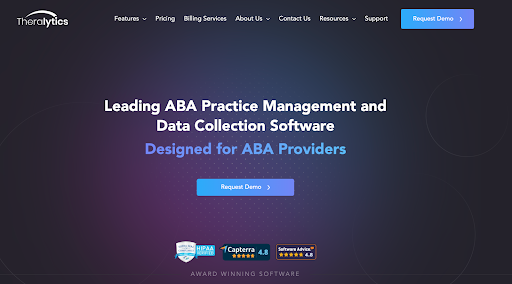
1. Theralytics — Best Overall for Clinical Efficiency Across the Practice
Key Specifications:
- Integrated practice management and real-time data collection
- Synchronous data sharing for BCBAs, supervisors, and clinicians
- Automated graphing and progress monitoring
- Parent/caregiver portal with outcome transparency
- Unified scheduling and billing interface
- Rigorous security compliance: Mandatory MFA, AES-256 encryption, SOC 2 Type II certified
Price Range:
- Free — Startup package (6 months or until first client)
- $20/client/month — Practice Management or Data Collection
- $30/client/month — Combined Practice Management + Data Collection
Disclaimer: Pricing may change and fees may apply for additional services. Contact Theralytics for exact costs.
Pros:
- Synchronized clinical data eliminates silos
- Automated graphing delivers rapid clinical insights
- Intuitive interface accelerates clinician proficiency
- Scalable pricing supports growth
- Enterprise-grade compliance and security
Cons:
- Using standalone modules with third-party systems may require custom API work
Detailed Review:
Theralytics seamlessly merges clinical and operational workflows into a unified platform that purposefully eliminates friction between care delivery and administrative processes. Its real-time data synchronization means that supervisors and BCBAs always act on current, accurate information — not outdated spreadsheets or disconnected apps.
Clinical Efficiency Gains:
Therapists benefit from fast, offline-capable data entry, while automated graphing instantly visualizes progress — eliminating tedious manual charting and accelerating treatment adjustments. Scheduling and billing are tied directly to session-level data, removing redundant documentation tasks and ensuring maximum clinical time is spent where it matters: with clients.
Safety & Compliance:
Theralytics meets or exceeds 2026 HHS technical safeguard requirements, including biometric MFA and audited access trails, making it ideal for practices where data integrity and continuity of care are core priorities.
Ideal User:
Practices of all sizes that prioritize clinical clarity, rapid decision-making, and operational alignment — especially those scaling client volume without sacrificing quality.
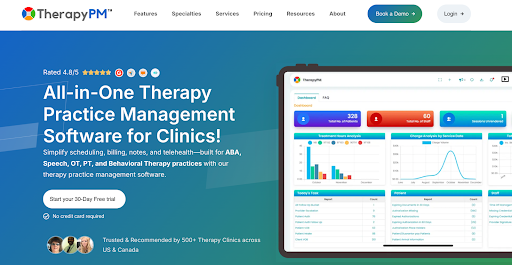
2. TherapyPMS — Best for Billing-Linked Clinical Workflow Efficiency
Key Specifications:
- Comprehensive billing and claims management
- Insurance verification and authorization tracking
- Revenue cycle reporting and analytics
- Integrated scheduling and documentation
- EVV and multi-payer support
Price Range:
Custom pricing based on practice size and billing volume
Disclaimer: Pricing varies based on billing complexity.
Pros:
- Advanced billing engine improves revenue visibility
- Strong authorization tracking reduces clinical disruptions
- Financial analytics support operational decision-making
- Consolidates scheduling and documentation workflows
Cons:
- Clinical features are functional but less comprehensive
- Interface can feel overwhelming initially
- May be overkill for practices with simple billing
Detailed Review:
TherapyPMS improves clinical efficiency by reducing the administrative attrition typically caused by billing errors, authorization lapses, and claim denials. While it’s not a clinical-first platform, its tight integration between scheduling, documentation, and billing ensures that administrative “afterthoughts” don’t pull clinicians away from care delivery.
Efficiency Through Financial Clarity:
By accelerating insurance verification, authorization tracking, and claim processing, TherapyPMS removes common revenue bottlenecks that often force clinical leaders to spend time on non-clinical work — improving both clinician focus and practice sustainability.
Ideal User:
Practices with billing complexity, high authorization requirements, or those experiencing administrative overhead tied to revenue challenges.
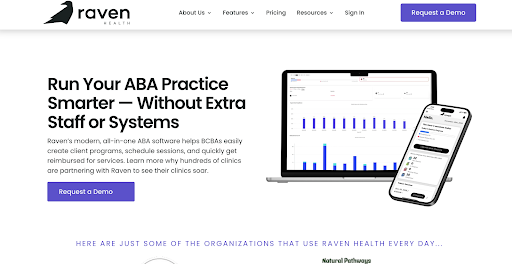
3. Raven Health — Best for Mobile-First Clinical Teams and In-the-Field Efficiency
Key Specifications:
- Mobile-first architecture optimized for field, home-based, and school-based delivery
- Offline data collection with automatic sync
- AI-powered session note generation
- Real-time clinical dashboards
- Shared care planning and collaboration portals
Price Range:
Custom pricing (contact Raven Health)
Disclaimer: Pricing varies based on practice size and chosen modules.
Pros:
- True mobile-first solution for real-world ABA workflows
- AI-assisted clinical documentation
- Real-time syncing improves accuracy & decision-making
- Caregiver engagement tools bolster family-centered care
Cons:
- Enterprise features continue to evolve
- Pricing is custom and not publicly listed
Detailed Review:
Raven Health was conceptualized and built by a BCBA who intimately understood the inefficiencies of legacy, desktop-centric systems — especially for clinicians constantly on the move. The platform’s mobile-first design acknowledges that modern ABA work is fluid, happening wherever clients are.
Mobile Efficiency:
Offline-compatible data collection and real-time synching ensure that clinicians can input session data immediately, reducing end-of-day documentation workloads and improving data accuracy.
AI-Assisted Documentation:
By accelerating session note generation while maintaining clinical quality, Raven Health significantly reduces the administrative burden on therapists — translating into more time focused on direct client care.
Collaboration & Communication:
Integrated communication tools keep teams aligned, simplify supervisory workflows, and enhance caregiver engagement — all contributing to smoother clinical operations.
Ideal User:
Small to mid-sized practices with field-based teams — particularly those focused on in-home or school-based services and needing modern, clinician-friendly tools.
4. ABA Matrix — Best for Clinical Customization and Complex Protocol Support
Key Specifications:
- Highly customizable clinical programming and behavior plan architecture
- Flexible and diverse data collection methods
- Comprehensive assessment libraries
- Custom reporting and analytics
- Multi-location practice support
- Insurance billing integration
Price Range:
Custom pricing based on practice size and selected modules
Disclaimer: Pricing varies based on practice needs.
Pros:
- Deep clinical flexibility unmatched by many competitors
- Extensive assessment and curriculum libraries
- Strong analytics and reporting capabilities
- Scales across multiple locations
Cons:
- Steeper learning curve due to extensive options
- Interface feels less modern than newer platforms
- Initial setup and configuration can be complex
Detailed Review:
ABA Matrix stands apart for its unmatched customization — empowering BCBAs to tailor every aspect of programming, data collection methodologies, and progress visualization. Rather than imposing rigid templates, it adapts to your clinic’s clinical approach.
Clinical Efficiency Impact:
When clinical staff can implement tailored treatment plans without workarounds or improper structures, accuracy and quality improve — driving faster, more meaningful outcomes. The platform’s robust reporting capabilities further help clinical leaders identify patterns, inform treatment pivots, and optimize care pathways.
Ideal User:
Established practices with advanced clinical teams that value customization and clinical precision over plug-and-play simplicity.
5. Rethink Behavioral Health — Best for Clinician Training and Clinical Quality Scaling

Key Specifications:
- Deep video-based training libraries
- Built-in RBT certification program
- Integrated clinical management tools
- Family/caregiver engagement portals
- Treatment planning, progress monitoring, and reporting
Price Range:
Custom pricing
Disclaimer: Pricing varies based on modules and number of users.
Pros:
- Reduces onboarding time and training costs
- Comprehensive evidence-based clinical content
- Parent engagement resources extend therapy beyond sessions
- Balanced clinical & administrative features
Cons:
- Interface can feel less intuitive than modern alternatives
- Occasional sync delays reported by users
- Training volume may be excessive for smaller teams
Detailed Review:
Rethink Behavioral Health brings clinical efficiency through structured, scalable training and certification — a critical advantage for practices hiring new clinicians or managing turnover. Its expansive educational resources and streamlined RBT certification program reduce the burden on internal BCBA supervision while ensuring consistent program quality.
Expanding Clinical Capacity:
By aligning training, treatment planning, and documentation within one platform, Rethink creates a cohesive environment where clinicians can learn, apply, and iterate more efficiently.
Family Engagement:
The integrated parent portal empowers caregivers to participate meaningfully in their child’s care — reducing follow-up calls, clarifying expectations, and sharing progress in a unified way.
Ideal User:
Growing practices focused on strengthening clinical consistency and accelerating new clinician readiness.
Conclusion
Improving clinical efficiency in ABA practice management requires more than a checklist of features — it demands software that aligns with how clinicians think, document, and deliver care. The 5 platforms above each excel in different areas of efficiency:
- Theralytics streamlines clinical workflows from data entry to insights
- Raven Health enhances productivity in mobile and field settings
- ABA Matrix provides granular clinical control for advanced teams
- Rethink Behavioral Health equips teams with training and standardization tools
- TherapyPMS strengthens efficiency through billing and authorization alignment
In 2026, the highest-performing ABA practices are those that remove operational friction, empower clinicians with real-time insights, and ensure administrative tasks never eclipse care delivery.