Laser Cataract Surgery Punta Gorda: When You Should Not Be Billed for the Laser

Medicare covers the core cataract procedure—blade or femtosecond laser makes no difference. What it doesn’t pay for are the extras some Punta Gorda clinics fold into a “laser upgrade,” a bundle that can run about $1,200 per eye. Use this guide—and our experience navigating Medicare rules—to spot the laser-related charges that truly add value (premium lenses or elective astigmatism correction) and skip the rest, so both your vision and your wallet stay clear.
When You Shouldn’t Be Charged Extra
Covered Cataract Surgery with a Standard Lens
Original Medicare pays your surgeon and the surgery center the same amount whether the cut is made with a steel blade or a femtosecond laser. That payment already covers three core steps:
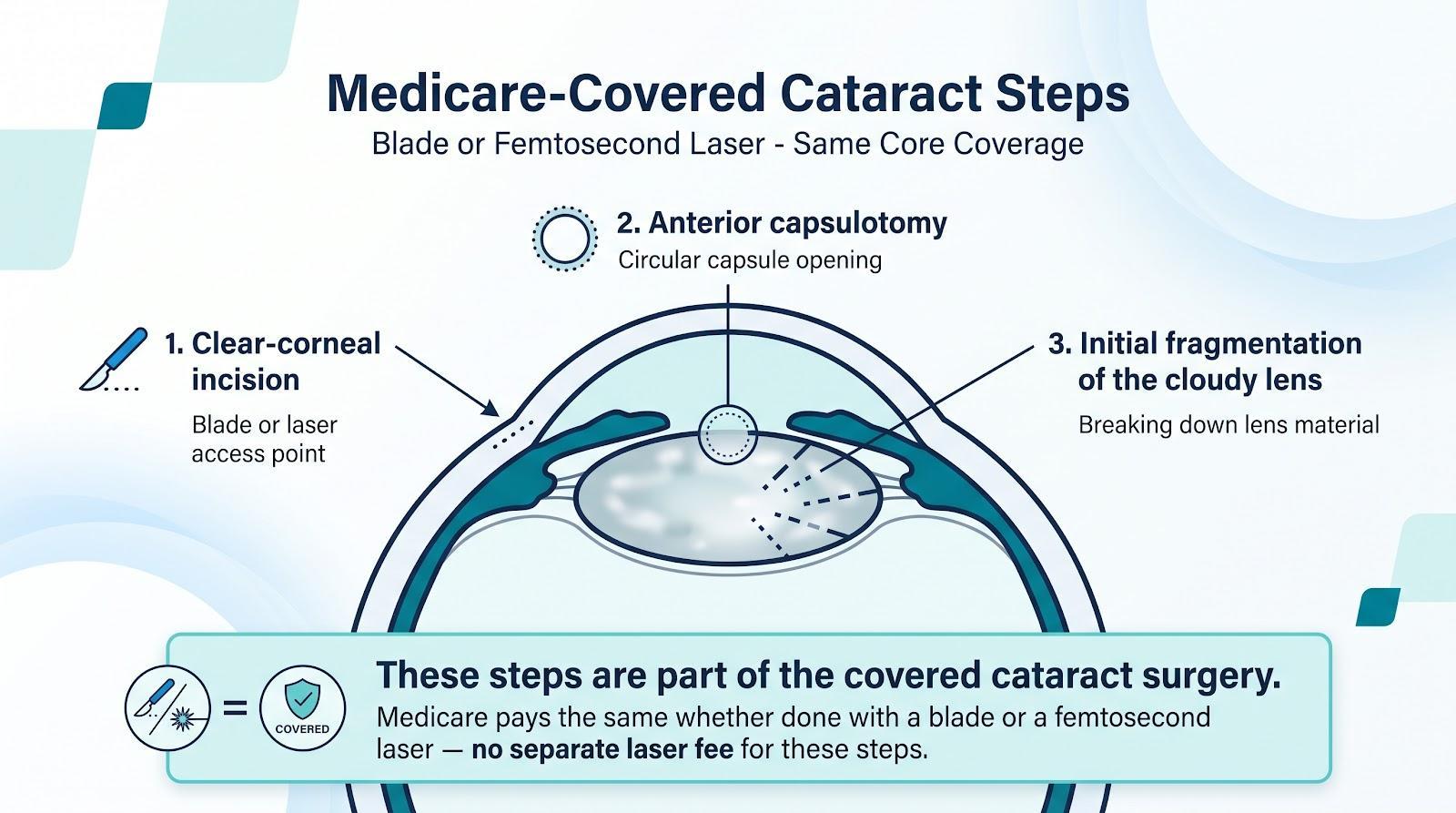
- clear-corneal incision
- anterior capsulotomy
- initial fragmentation of the cloudy lens
CMS puts it plainly: “Medicare coverage and payment for cataract surgery is the same irrespective of whether the surgery is performed using conventional surgical techniques or a bladeless, computer-controlled laser.” (CMS guidance)
At billing time you still owe your usual Part B deductible (if it is not yet met) plus 20 percent coinsurance. No line-item “laser fee” can be added unless it pays for a service Medicare never covers, such as a premium intraocular lens allowed under CMS Rulings 05-01 or 1536-R. If the quote includes a mandatory laser charge, pause and ask the staff which elective upgrade it funds; if they cannot name one, the fee fails the Medicare test.
When an Extra Charge Can Be Legitimate
Premium or Advanced-Technology Lenses
Medicare covers a conventional monofocal IOL (one point of focus, no frills). If you want more range or built-in astigmatism correction, you can choose a premium lens:
- Multifocal or extended-depth lenses for near-to-far focus
- Toric lenses for corneal astigmatism
- Light-adjustable lenses that can be fine-tuned after surgery
CMS Rulings 05-01 (presbyopia-correcting) and 1536-R (astigmatism-correcting) allow your surgeon to bill you for the incremental cost of that premium upgrade. National consumer data place the surcharge in the $1,000–$3,000 per-eye range.
In practice, the bill should show three separate lines:
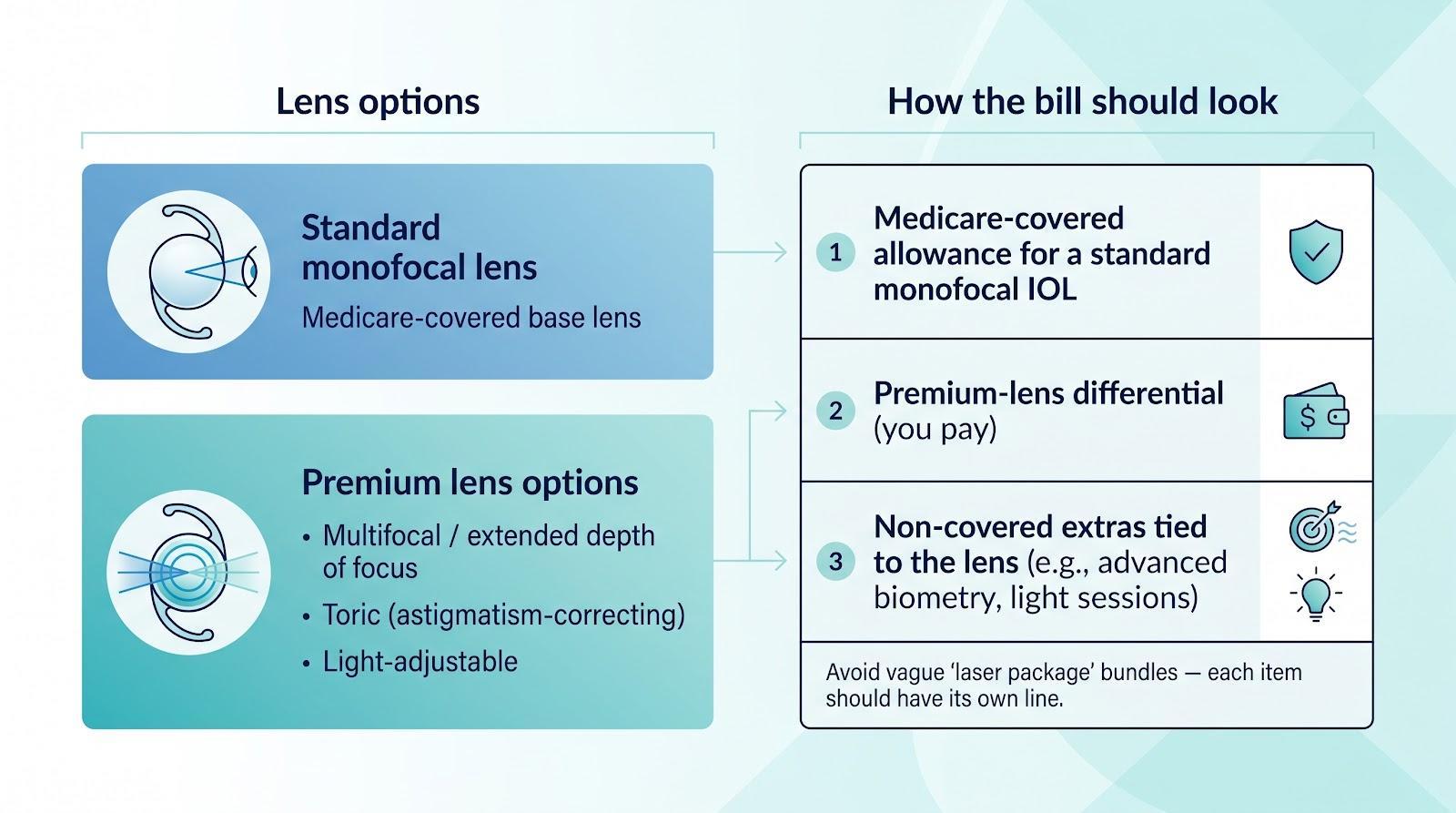
- Medicare-covered allowance for a monofocal IOL
- Premium-lens differential you pay
- Non-covered extras tied to that lens (for example, high-resolution biometry or ultraviolet light sessions for a light-adjustable model)
If a clinic lumps those items under a vague “laser package,” it muddies the legal line between covered surgery and elective perks. Ask for a clear rewrite so every dollar has a label.
Local Reality Check: Where Your Surgery Actually Happens
A Punta Gorda street address on your appointment card does not guarantee a Punta Gorda operating room. Consult offices in Punta Gorda and Port Charlotte frequently route patients to accredited surgery centers in Fort Myers, Naples, or Sarasota. That gap matters twice over: it changes your travel plan on surgery day, and it can change which facility fee and which anesthesia group land on your bill.
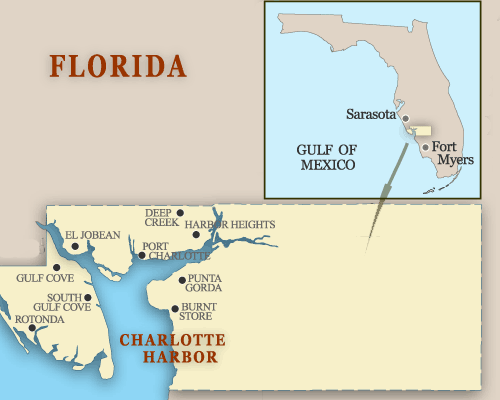
Map Showing Punta Gorda Consult Offices and Out-of-Town Cataract Surgery Centers
Before you commit anywhere, ask three questions:
- Who is the operating ophthalmologist?
- Where is the accredited surgery center, and is it in my network?
- Exactly which service does any laser fee cover?
Snead Eye Group cataract surgery offers one example of what those answers can look like. The practice has invested more than $1 million in diagnostic technology, and Dr. Brad Snead—with offices in Fort Myers, Naples, Cape Coral, and Bonita Springs—keeps manual phacoemulsification as the default, bringing out the LenSx femtosecond laser only when it adds measurable value for a particular eye. Patients weighing cataract surgery in Punta Gorda can put the same three questions to any practice they visit. The answers, not the brochure, tell you what you are paying for.
How to Decode a Cataract-Surgery Quote
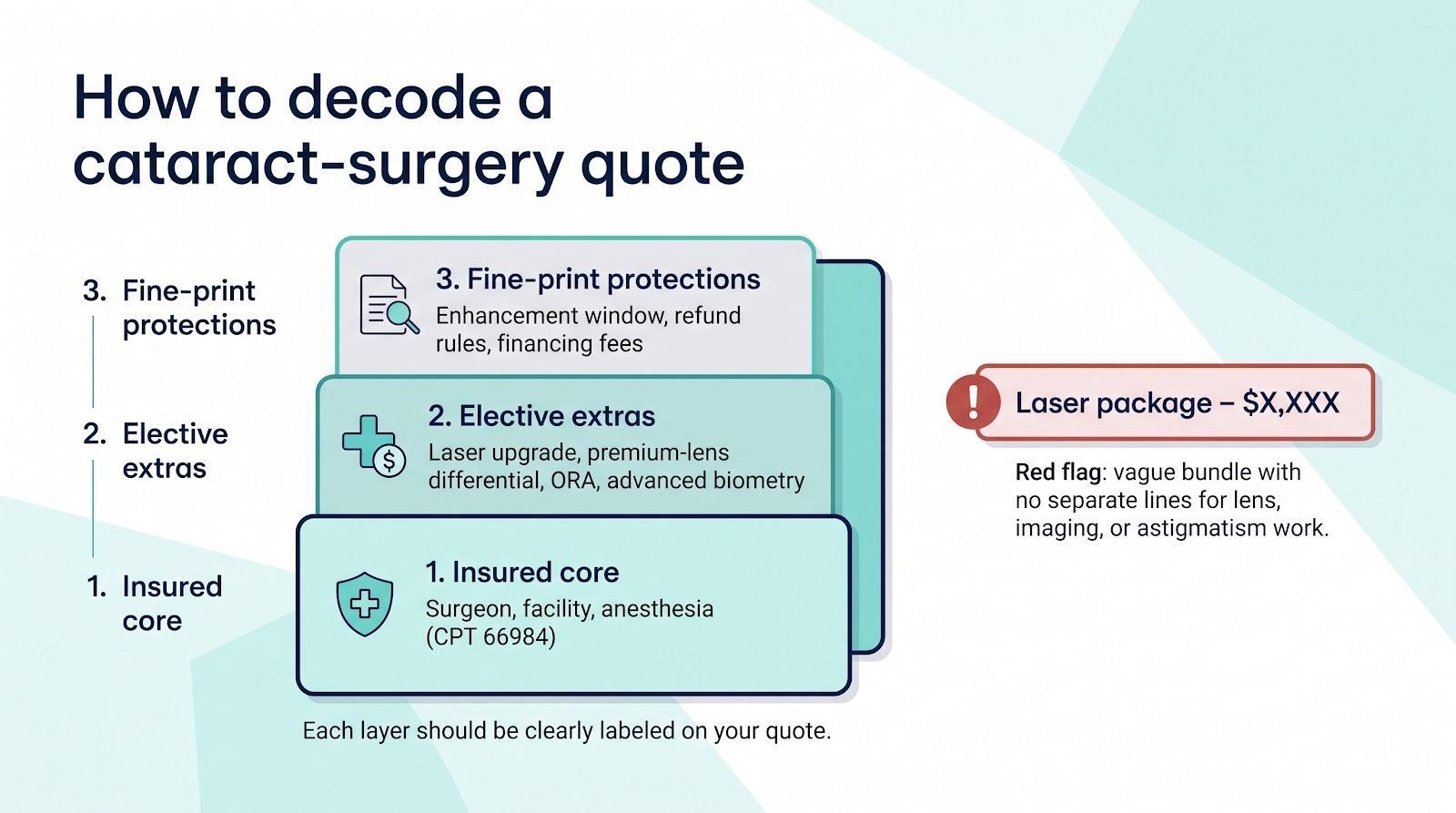
The estimate may look like a phone number, yet every line has a purpose. Break it into three layers:
1. The insured core: surgeon, facility, and anesthesia. Check CPT 66984 in Medicare’s online Physician Fee Schedule or ask the billing office for your exact local allowance. Your share is the Part B deductible (if it is not met) plus 20 percent coinsurance.
2. The elective extras: often labeled laser upgrade, refractive package, ORA/intra-op aberrometry, advanced biometry, or premium-lens differential. Medicare does not cover these services, so the practice sets the price. Nationally, adding a premium lens or laser assistance can increase the bill by $1,000 to $3,000 per eye on top of standard coverage. Charlotte County providers publish few figures, so the number on your personal quote is the one that matters.
3. Fine-print protections: enhancement windows, refund rules, and financing fees. Coverage can run 90 days to a full year. If any clause is unclear, ask for a clearer rewrite before you pay.
Red flag: any lump sum called “laser package” with no separate lines for lens, imaging, or astigmatism work. Under CMS rules, clarity is not a courtesy; it is your right as a patient and a consumer.
Manual vs. Laser: What the Evidence Shows
Randomized trials such as FACT (United Kingdom) and FEMCAT (France) found that conventional phacoemulsification is non-inferior to femtosecond-laser–assisted cataract surgery (FLACS) for uncorrected visual acuity, complications, and patient-reported quality of life at 6–12 months. A 2022 AAO technology assessment agrees: routine eyes see just as well either way, while FLACS costs more.
Where FLACS shines is geometry. Researchers measured capsulotomy precision within ±0.07 mm of the planned diameter and recorded lower ultrasound energy and time than with manual cuts. Those gains can help in dense cataracts or subluxated lenses, yet they rarely improve the vision you notice day to day.
Economics tell a similar story. A 2023 cost-effectiveness analysis from the FEMCAT trial showed FLACS raised the mean surgical cost by about $600 per case without delivering a cost-effective gain in quality-adjusted life years, and Medicare reimbursement stayed flat. That gap explains why practices often pair the laser with premium-lens packages.
Our bottom line: a skilled surgeon can deliver excellent results with or without the laser. Ask what problem the laser solves for your eye, and make sure any surcharge funds a benefit you value, not just a newer tool.
Red Flags and Charges That Aren’t Automatically Wrong
Red flags to question
- A blanket “laser fee” with no description beyond “Medicare won’t pay.” CMS allows charges only for non-covered services such as premium IOLs or refractive astigmatism cuts, not for the covered cataract steps themselves.
- Pressure tactics (“today-only price,” a request to swipe your card before you meet the surgeon). Cataract surgery is almost never an emergency, so you can take time to compare.
- A single lump sum that bundles lens, laser, imaging, and “enhancement coverage.” Ask for each item on its own row; a transparent office can separate them in minutes.
Legitimate extras
- Premium-lens differential (presbyopia- or astigmatism-correcting IOLs).
- Laser arcuate incisions that reshape the cornea for elective astigmatism correction.
- High-resolution biometry or intra-operative aberrometry ordered only for premium lenses.
What still arrives as separate, insured bills
- Ambulatory surgery center (ASC) fee.
- Anesthesia services.
You’ll pay the standard Part B deductible and 20 percent coinsurance on those insured amounts; that split comes from Medicare, not your surgeon. We suggest a simple rule: if every line item passes the explain it over coffee test, you’re on solid ground. If it needs a slideshow, keep asking until the numbers make sense.
15 Smart Questions to Ask Before You Commit
Bring this checklist to your consult and wait for written answers. Confident staff will not need to “check with billing.”
Coverage and cost
- Is this medically necessary cataract surgery or elective lens exchange?
- Which fees go to insurance (surgeon, facility, anesthesia) and which are cash?
- What is Medicare’s dollar allowance for a standard monofocal lens?
- If I see a laser fee, what non-covered service does it buy (premium lens, astigmatism arcs, or something else)?
- May I choose manual surgery yet still upgrade to the same premium lens?
Technology specifics
6. Will the laser cut astigmatism arcs, and is that listed as a separate line item?
7. How many laser and how many manual cases has the surgeon performed in the past 12 months?
8. Which laser platform is planned, and why does it fit my eye?
People and place
9. Who is the operating ophthalmologist, and will I meet them before surgery day?
10. Where will the surgery occur, and are the surgeon, facility, and anesthesia in my network?
Aftercare and what-ifs
11. What does postoperative care include (for example, refractions, drops, or enhancements)?
12. How long does any enhancement guarantee last, and what triggers extra charges?
13. If I cancel, how much of my deposit is refundable?
14. What happens financially if the premium lens does not meet the promised range of vision?
15. Can I take this itemized quote home to review before signing?
Already Paid? Here’s How to Review and Dispute
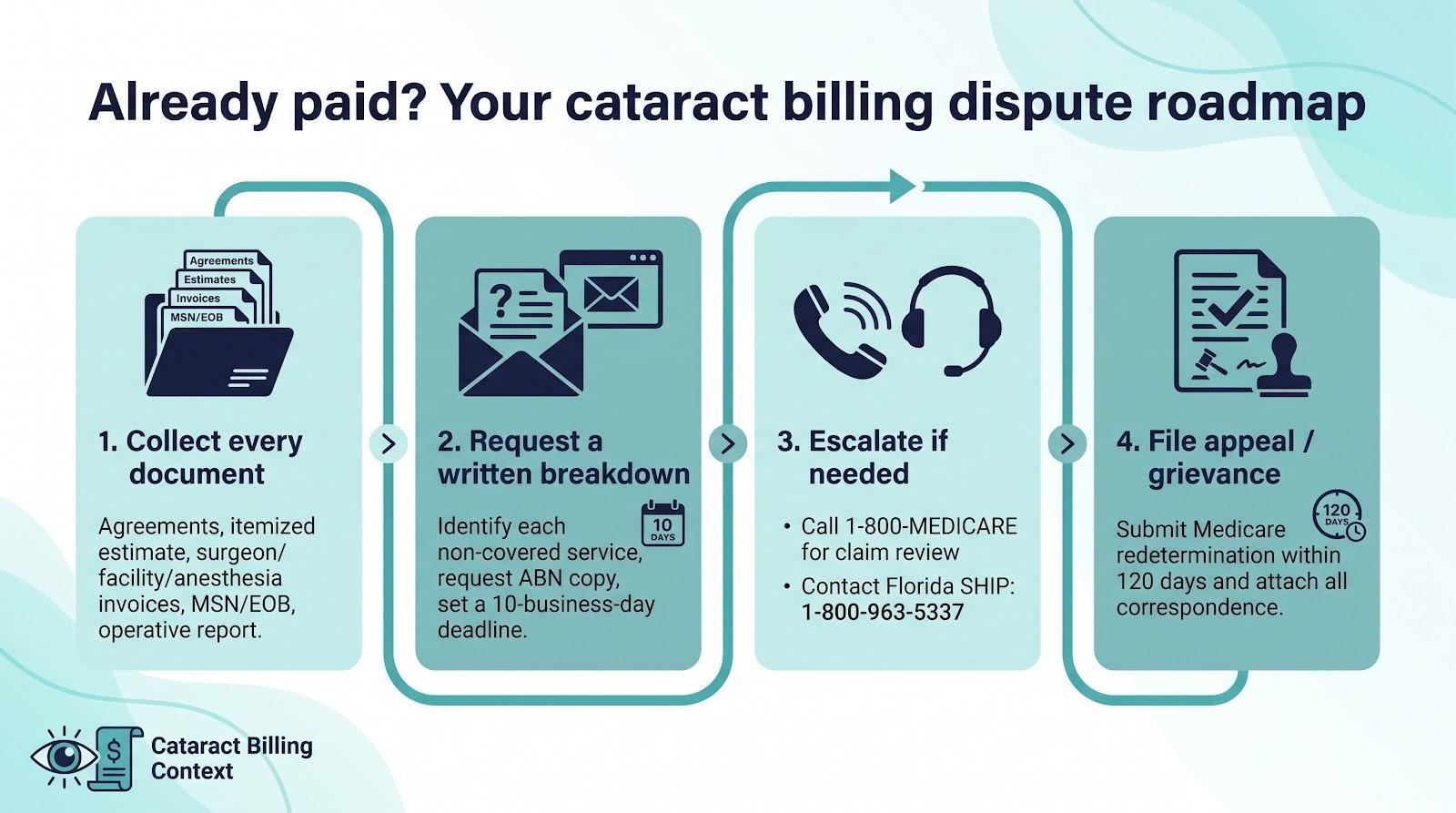
1. Collect every document. Gather the signed financial agreement, itemized estimate, surgeon, facility, and anesthesia invoices, your Medicare Summary Notice (MSN) or insurer explanation of benefits (EOB), and the operative report if you have it.
2. Request a written breakdown. Email or mail the billing office:
- Identify each non-covered service (for example, premium lens or laser astigmatism arcs).
- Provide a copy of any Advance Beneficiary Notice (ABN) the office says you signed.
- Set a 10-business-day deadline for a written response.
3. Escalate if needed.
- Call 1-800-MEDICARE or your plan’s member-services line and request a claim review, citing possible balance billing for a covered cataract step.
- Contact Florida’s State Health Insurance Assistance Program (SHIP) at 1-800-963-5337 for free counseling.
4. File a formal appeal or grievance.
- Submit a Medicare redetermination within 120 days of the MSN date; commercial plans usually allow a similar window, so check your policy.
- Attach all correspondence and keep copies for your records.
Persistence pays. Clinics prefer to avoid regulator scrutiny, and a clear paper trail often leads to partial or full refunds.
Know Who Does What
Eye-care titles are not interchangeable.
Ophthalmologist (MD or DO). Completed medical school plus four years of surgical residency. Performs the cataract removal and appears on the Medicare surgical claim.
Optometrist (OD). Doctor of optometry who diagnoses vision problems, treats many eye diseases, and often manages pre- and postoperative visits, yet does not enter the operating room to remove a cataract.
Many practices follow a co-management model: an OD handles the work-up and follow-ups, while the surgeon arrives on surgery day. That approach can work, but you should meet—or at least speak with—the operating ophthalmologist before you sign consent. Knowing the surgeon’s name, experience, and approach is your right well before any IV is placed.
Assess the Surgeon, Not Just the Machine
Ask for numbers, not slogans:
- Case volume. “How many manual and how many laser cataracts did you perform in the past 12 months?” A surgeon confident with both methods can tailor the approach to your eye.
- Complex cases. “Have you treated dense cataracts, prior LASIK, Fuchs’ dystrophy, or small pupils, both with and without the laser? What were the outcomes?” Real examples matter more than glossy claims.
- Results and revisions. “What is your posterior-capsule rupture rate? How often do you perform a touch-up or YAG laser after premium-lens cases?” Surgeons who know their data invite a second opinion.
You can check licensure or disciplinary history through the Florida Department of Health license lookup and compare complication benchmarks in the AAO’s IRIS Registry reports. When the conversation stays grounded in data—skill first, tool second—you choose a partner, not a platform.
Conclusion
Confirm exactly what any laser fee covers, insist on clear itemized billing, and remember that Medicare already pays for the core cataract procedure.