How to Use the British Journal of Nursing for an Adult Nursing Personal Statement and Assignments
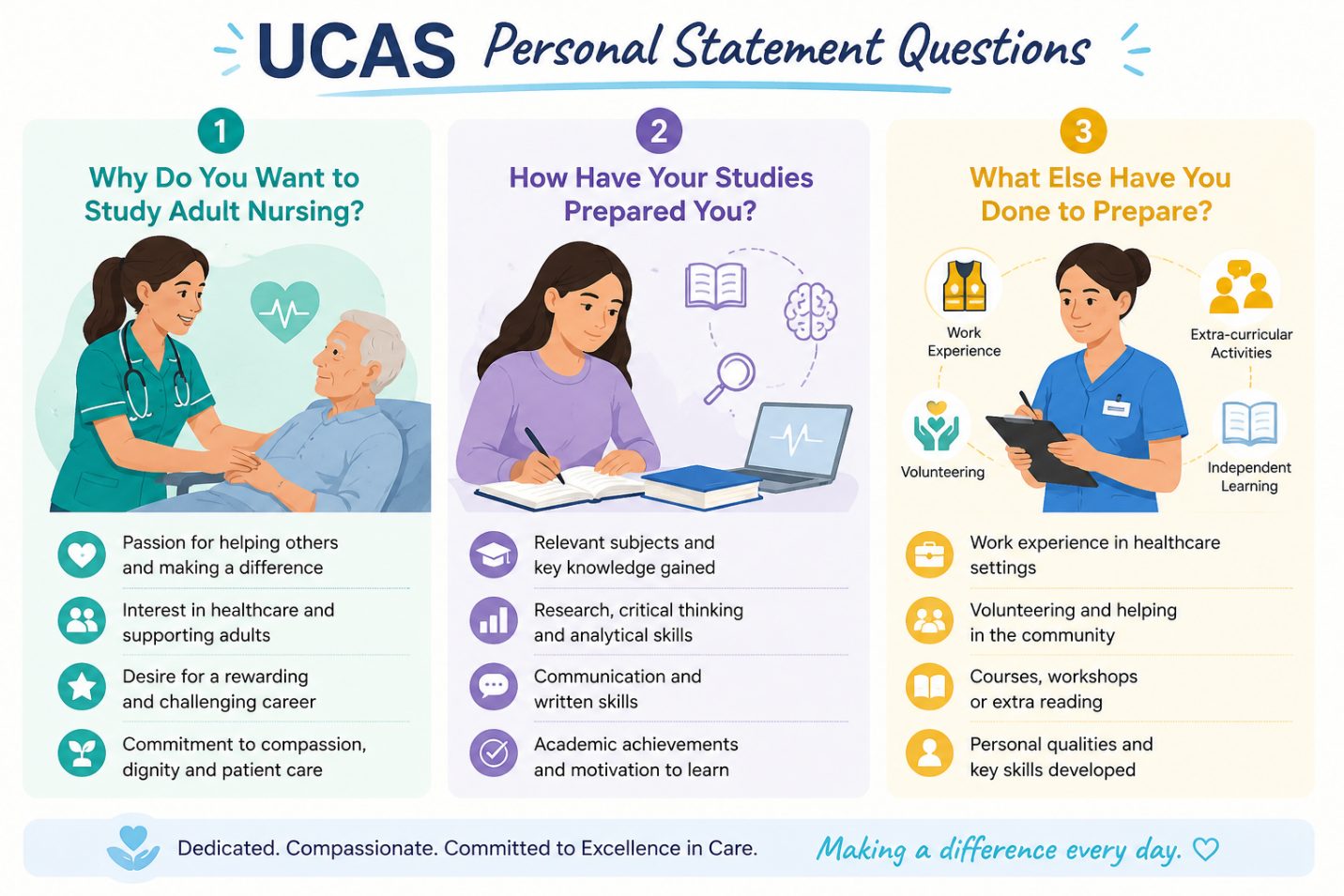
Introduction: What is Changed for 2026?
As time has passed, the medical field has advanced, evolving its strategies for assessing patients, diagnosing underlying diseases, and providing efficient care. Students applying to an adult nursing course in 2026 will see an important change to the UCAS personal statement for adult nursing. Applicants are no longer required to write a single personal statement, but are asked to answer three structured questions that contain a maximum of 4,000 characters combined, with a minimum of 350 characters per answer (UCAS, 2025). Furthermore, it is important to keep in mind that the new format requires you to discuss your interest, academic background, and experiences clearly and concisely. Competition is real: in the 2020 cycle, a record 40.5% of all UK adults aged 18 or older have applied to UCAS, and initially, 4 out of 10 adults applied and demand for the healthcare courses has remained strong. Basically, the core focus of the universities is to assess your understanding, learning, and experience regarding adult care in various health contexts. Therefore, this guide provides you with an adult nursing personal statement sample and explains how to write an adult nursing personal statement so that your query can be answered efficiently. And if you would rather refine than start from scratch, a specialist admission essay writing service, or targeted admission essay help with your existing draft, can tighten your answers without replacing your voice.
Why Do You Want to Study Adult Nursing?
This is the most common question that is asked everywhere in nursing when you are going for admission. In UCAS, this is the first question that allows an applicant to share personal thoughts regarding the nursing field.
Understand, through an example, how to answer this question;
Use specific words like "people" rather than generic terms like "I want to help people" because so many candidates use the same phrases that say nothing. Instead, describe what specifically interests you about working with adults and how your interest has evolved.
Why is it important to use these kinds of terminologies?
If you use this terminology, you will be able to impress your assessor by describing your desire to help adults with chronic illnesses and to provide comprehensive support that takes into account their physical, emotional, and social needs.
You may also include experiences that brought you into contact with healthcare, but rather than describing personal experiences, focus on what you learned from them, such as volunteering, observing healthcare workers, or helping a family member.
Have a review of some good starting points
- “The development of interest in adult nursing was through….”
- “To improve independence among adults and maintain their dignity was a key factor that motivated me to start my nursing journey"
- “Adult nursing appeals to me as it is a combination of clinical skills and caring for people as individuals.”
How Have Your Studies Prepared You?
- The second question relies on your academic progress. In this question, your evaluator will assess your adult nursing career motivation statement and how your education has prepared you for studying adult nursing. If you are studying A-levels, Access to Higher Education Diploma, BTEC or another recognised route to higher education, concentrate on what you have learnt and the skills you have developed that can be transferred to future studies.
- This adult nursing personal statement guide helps you understand human health, communication, and patient care through relevant subjects like Biology, Health and Social Care, Psychology, Chemistry, or Sociology. If you have learnt these subjects, you can easily answer the question and emphasise critical thinking, teamwork, organisation, research, and effective communication.
💡 Hint:
Rather than just saying that you studied Biology, explain how it helped you to better understand disease processes or body systems. It enhances your answer by providing a link to your studies and nursing.
What Else Have You Done to Prepare?
- The third UCAS question is assessed holistically by universities because assessors look for evidence of practical working knowledge of the profession. You may have some relevant experiences in the healthcare sector that help you prepare, such as:
- Healthcare assistant role
- Hospital volunteering
- Supporting residents in care homes
- Community health initiatives
- Opportunities to volunteer with charities
- Completed first aid training and shadowing healthcare professionals.
❌ Never say just what they do!
✓ Discuss what they learned from each experience.
While addressing this question, you can mention the importance of communication skills, care at home, voluntary work in the healthcare sector or at home, maintaining dignity and respect, and teamwork. This experience will help you demonstrate how you have prepared yourself for adult health. Share your skills without giving away confidential information about people. Emphasise traits like
- Empathy
- Resilience
- Time management
- Adaptability
Demonstrating Professional Values
An adult nursing personal statement template can show you the shape of a strong answer, but the values inside it must be your own. It is important to understand that your writing should demonstrate the values that are expected of future nurses in your answers. If you do this successfully, you will highlight key attributes, including compassion, integrity, effective communication, and a commitment to patient-centred care.
- Never mention personal information of the patient (like their name)!
- Always maintain confidentiality
Key Notes: Always focus on the ongoing need for professional development, an evidence-based approach, and interprofessional working. When writing a university personal statement for adult nursing, ensure patient safety. You must practice using the adult nursing personal statement format so that your ability to answer can be improved. You should also read adult nursing supporting statements before applying to universities so that you have a clear picture of how to answer.
Common Mistakes to Avoid
If you have carefully read and practised the adult nursing personal statement structure, you will avoid the common mistakes that applicants usually make.
- Using stock phrases and giving no reason why you are interested in adult nursing in particular.
- Inadequately mentioning what skills you have gained and their relevance to adult health nursing.
- Overstate your duties or say that you have done things that you have not.
- You must not copy and paste or avoid using AI because it breaches policy and will impact your marks. So you need to write in your own words.
- Giving inappropriate examples will reduce your marking.
Final Thoughts
How you close matters: a strong adult nursing personal statement conclusion should tie your motivation, studies, and experience into one forward-looking line.
You should write a good personal statement without making it general or irrelevant. Your adult nursing placement experience statement should reflect your skills, ability to maintain confidentiality, and professionalism. After drafting, look for constructive feedback to enhance the structure, clarity and overall effectiveness of your draft, but without losing your own voice. By using professional nursing assignment help, and editing and proofreading services, you can highlight areas that need improvement.
Conclusion
In conclusion, adult nursing personal statements should be clearly written by the candidates. According to the updated UCAS format, candidates must answer three questions, providing a comprehensive reflection on their interests in nursing. In this blog, strategies to answer these questions are provided along with common mistakes that you need to avoid.
FAQs
How do you write an adult nursing personal statement?
Be clear and articulate, emphasising motivation, applicable experiences, nursing values, transferable skills, and dedication to safe, caring patient care.
What should be included in an adult nursing personal statement?
Factor in the motivation to nurse, academic history, healthcare experience, communication skills, teamwork, empathy and a commitment to further education.
How long should an adult nursing personal statement be?
From 2026 entry, the three UCAS questions share a combined limit of 4,000 characters, roughly 550 to 650 words, with a minimum of 350 characters per answer, so aim for forced answers rather than a fixed word count.
What skills should be mentioned in an adult nursing statement?
Communication, teamwork, empathy, problem-solving, organisation, resilience, time management, adaptability, and patient-centred care skills are the skills assessors look for.
How can work experience strengthen a nursing personal statement?
Work experience provides real-life evidence of understanding, patient interaction, dedication to the nursing profession, and preparedness for training.